


Why do sheet metal parts warp or bend when welded together? An illustrated explanation of the mechanism.
Introduction
In sheet metal fabrication, distortion caused by welding and warping are unavoidable challenges. Even when manufacturing strictly to design drawings, it is not uncommon for the finished product to warp, making assembly difficult.
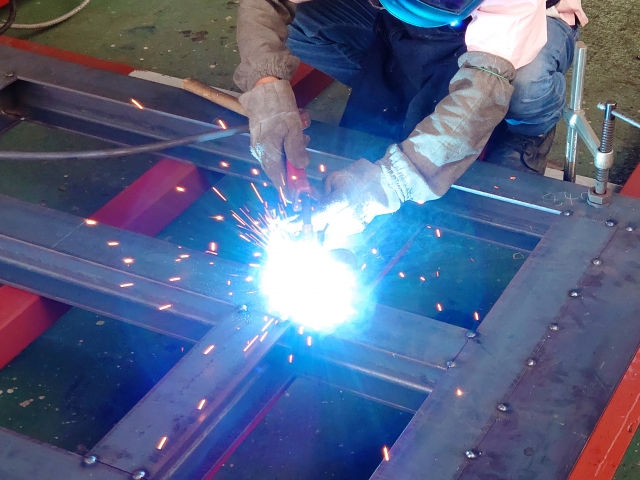
So why does such deformation occur when welding? This article explains the causes, mechanisms, and countermeasures in detail.
1. The effect of heat generated during welding

Welding is a method of joining metals by locally melting them using a heat source such as an arc or laser.
However, metals possess the property of expanding when heated.

When welding commences, the joint between the sheet metal components rapidly heats up and attempts to expand to the dashed line. However, the surrounding area remains cold and fixed, preventing this expansion. Consequently, compressive stress develops within the sheet metal joint.
2. Reduction in Young's Modulus and Compressive Stress
As the metal heats up and begins to melt, it loses its ability to maintain its shape (its Young's modulus decreases), and the compressive stress also diminishes accordingly.

3. Initiation of Metal Cooling and Generation of Tensile Stress
Upon completion of metal melting and entry into the cooling phase, the molten section attempts to contract to the dashed line. However, this contraction is impeded by the surrounding metal, causing tensile stress to develop internally.

4. Generation of Residual Stress
As cooling progresses, the Young's modulus of the metal recovers and tensile stress increases. This stress constitutes residual stress. Not only tensile stress, but the vicinity of the welded joint may also experience compressive stress, as it is subjected to tensile stress.
If this stress remains while the fixture is released, it can cause warping or distortion.

Such distortions occur not only in the welding of sheet metal parts but also in 3D printers that shape objects by laser sintering metal powder. See here ➡ Point to note when handling 3D printers ①
Specific Types of Welding Distortion
Welding-induced deformation exhibits several typical patterns.
Shrinkage Deformation
The most common is shrinkage caused by contraction along the weld line. Example: After a long weld, the component shortens along the weld line.
Angular Deformation
When the plate thickness at the weld is thin or single-sided welding is performed, the welded section may warp, altering its angle. Example: L-shaped sheet metal assemblies fail to maintain right angles, opening or closing.
Warpage
Welding large plates may cause only the weld area to contract, resulting in the entire plate warping into a bow shape. Example: Wavy surfaces on car door panels or outer panels.
Torsional Deformation
Welding at asymmetrical positions can disrupt lateral balance, causing overall twisting.
Relationship Between Plate Thickness and Distortion
Plate thickness significantly influences distortion occurrence.
Thin plates (approximately 1–3 mm)
Heat effects readily penetrate to the reverse side, causing substantial deformation. Stainless steel and aluminium, in particular, are prone to distortion due to their high thermal conductivity and expansion rates.
Thick plates (5mm and above) exhibit minimal deformation due to the plate's inherent rigidity. However, residual internal stresses are more likely to remain, potentially causing warping during subsequent processing.
In essence, welding thin plates presents greater difficulty for products requiring high precision.
Representative countermeasures to prevent distortion
Limit heat input
Weld at low current
Select methods with minimal heat-affected zones, such as laser or resistance welding
Optimise welding sequence
Expand from the centre outwards
Weld symmetrically in alternating passes
Divide long welds into shorter segments
Utilise auxiliary fixtures
Weld while clamping or jigging
Suppress movement caused by heat
Post-weld correction
Distribute stresses through hammering
Remove residual stresses via annealing
Restore flatness through press correction
Summary
Welding sheet metal together causes distortion or warping due to:
Localised expansion from heating
Rapid contraction from cooling
Resulting residual stresses.
This is particularly pronounced with thin sheets or materials exhibiting high thermal expansion. On-site, it is crucial to combine countermeasures such as selecting heat input-reducing techniques, optimising welding sequence, utilising fixing jigs, and implementing correction processes.
Deepening this understanding can lead to improved product quality and enhanced yield rates.


Comments